Sunday, February 23, 2014
TOW #19: POM Wonderful Pomegranate Juice Packaging (Visual Text)
At first glance, one notices the strange shape of this bottle of pomegranate juice. When one looks closer, the first thing to jump out on the label is the heart present in the name, POM. Below that, the bottle says: "100% Pomegranate Juice". And on the back, it boasts, "100% California Pomegranates", directly above the nutrition information. First, by making the bottle an interesting shape, shoppers' attention is caught. Then, by using the heart symbol as well as repeated text, the POM Wonderful company effectively convinces people in the grocery store to buy the juice.
The strange shape of bottle catches shoppers' attention and makes them pause to take a closer look at the product. Also, shoppers may pick up the bottle and notice that the shape is comfortable in their hand, which could further convince them to buy it. However, the most convincing evidence is present on the bottle's label.
The juice bottle prominently displays a heart embedded in the name of the product. Subliminally, this makes shoppers associate the product's name with love, which can cause them to believe they like the product – without even knowing much about it. Also, health-conscious people may associate the heart with heart health – perhaps the pomegranate juice will be able to make their heart healthier in some way or another. Simply having a heart on the packaging, though, will not convince most people. Many shoppers will then read the text present on the bottle.
On the front, the label reads: "100% Pomegranate Juice". This further convinces potential buyers of its healthiness – it's completely natural, which people view as meaning it is more healthy. When they turn to the back to read the nutrition information, they see similar text: "100% California Pomegranates". Additionally, the text to the right of the nutrition information states: "All Natural 100% Juice". Again, the idea of an all-natural, healthy drink is reinforced. This large, bolded text helps to distract shoppers from the nutrition information, which reveals that the product contains 32 grams of sugar – quite a lot for such a small drink. However, since the "100% Juice"-promoting text is a lot larger and easier to read, that's all that most shoppers will pay attention to. Once thoroughly convinced that the juice is healthy and natural, many shoppers will decide it's a good buy.
Through its use of an attention-grabbing shape and numerous reminders of its healthiness, the POM Wonderful bottle effectively portrays to potential buyers that it would be a good, all-natural, healthy drink to buy. (And I can attest to its effectiveness, because there are about five of these bottles currently in my family's fridge.)
Wednesday, February 12, 2014
TOW #18: "Engineering the Ideal Olympian" by Erica Westly (via Popular Science)
With the Winter Olympics finally here, many Americans are excitedly rooting for their favorite snowboarders, skiers, and figure skaters. In "Engineering the Ideal Olympian" in the February issue of Popular Science, Erica Westly, a freelance writer who often covers the Olympics, writes about the new technology the US team is employing. She writes to an audience interested in both the Olympics and cutting-edge science and technology – a category that probably encompasses most of Popular Science's readership. Through the article, Westly both informs readers about the exciting events in the Winter Games as well as helps them understand how technology gives America an advantage. To achieve this, Westly makes use of intriguing diction and interesting pictures/infographics.
Clearly enthusiastic about the Olympics, Westly uses many adjectives to convey that interest to her readers. She writes, "Particularly in the Winter Games, technology – flawlessly designed for speed and safety – can mean the difference between standing on the podium and watching from the stands." Her use of "flawlessly" draws readers in and makes them wonder how that technology is designed so that it could have such a great effect on athletes' performance. Westly's overall use of interesting adjectives makes the article more exciting to read and therefore allows readers to focus on the significance of the technology Westly describes.
Since many of the new technologies Westly is describing are unknown to readers, pictures and infographics are extremely helpful for reader comprehension. When informing readers of the Catapult Sports Minimax S4 (a tool used by snowboarders), Westly discusses how the device measures velocity and G-force. To illustrate this, she includes a picture of a snowboarder mid-air in a half-pipe. The picture has the snowboarder's path drawn in, and has information boxes at spots that would be important to the athletes (ex. takeoff, maximum height, landing). This infographic gives readers a sense of how the device works as well as a better understanding of how the snowboarders can use the data. By including pictures and infographics, Westly effectively helps readers better understand how new technology can make Olympians more successful.
In "Engineering the Ideal Olympian", Erica Westly strives to inform readers of how new technologies are helping the US Olympic Team be victorious at the 2014 Winter Games. To achieve this purpose, she first draws readers in through her intriguing diction and then fosters understanding of the technology through detailed pictures and infographics. Ultimately, through this article, Westly is able to make more readers excited about the Winter Games and the prospects of victory that new technologies can bring.
Clearly enthusiastic about the Olympics, Westly uses many adjectives to convey that interest to her readers. She writes, "Particularly in the Winter Games, technology – flawlessly designed for speed and safety – can mean the difference between standing on the podium and watching from the stands." Her use of "flawlessly" draws readers in and makes them wonder how that technology is designed so that it could have such a great effect on athletes' performance. Westly's overall use of interesting adjectives makes the article more exciting to read and therefore allows readers to focus on the significance of the technology Westly describes.
Since many of the new technologies Westly is describing are unknown to readers, pictures and infographics are extremely helpful for reader comprehension. When informing readers of the Catapult Sports Minimax S4 (a tool used by snowboarders), Westly discusses how the device measures velocity and G-force. To illustrate this, she includes a picture of a snowboarder mid-air in a half-pipe. The picture has the snowboarder's path drawn in, and has information boxes at spots that would be important to the athletes (ex. takeoff, maximum height, landing). This infographic gives readers a sense of how the device works as well as a better understanding of how the snowboarders can use the data. By including pictures and infographics, Westly effectively helps readers better understand how new technology can make Olympians more successful.
In "Engineering the Ideal Olympian", Erica Westly strives to inform readers of how new technologies are helping the US Olympic Team be victorious at the 2014 Winter Games. To achieve this purpose, she first draws readers in through her intriguing diction and then fosters understanding of the technology through detailed pictures and infographics. Ultimately, through this article, Westly is able to make more readers excited about the Winter Games and the prospects of victory that new technologies can bring.
Snowboarding Infographic:
As described in the third paragraph, Westly uses an infographic to explain the Catapult Sports Minimax S4, a device snowboarders use. This graphic is interesting and informative enough that it allows readers to understand the way athletes use the device.
(Source: "Engineering the Ideal Olympian": Popular Science, February 2014, Page 37)
I'm a Stranger Here Myself Introduction (IRB)
When journalist Bill Bryson moved back to the United States after living in the UK for nearly twenty years, he was, as he writes, forcibly made to write a weekly column for an editor friend back in London. I'm a Stranger Here Myself is a compilation of those columns, which describe American life from the point of view of a (virtually) British person. The specific topics include normal parts of life like going to the post office or seeing advertisements that Bryson has managed to turn into hilarious stories, simply because he can look upon them with a different perspective than we can as Americans.
I chose to read this book because it seemed to be an interesting topic – after all, we think our everyday routines are normal, but they may seem absolutely alien to an outsider. Also, it was cited as being hilarious, and given that my two previous IRBs were somber and scientific (respectively), I decided to change it up a bit. Hopefully this book will open my eyes to the differences between American life and British life, as well as giving me a new perspective on things I view as normal. Also, I expect it to simply be entertaining as well.
Sunday, February 2, 2014
TOW #17: "Was standing ovation for women's pay just as fake as Don Draper?" by Maya L. Harris (via CNN.com)
Recently, President Obama addressed the issue of gender inequality (specifically dealing with wages) at the State of the Union. His announcement that a "women deserves equal pay for equal work" was met with a standing ovation. However, in the opinion article "Was standing ovation for women's pay just as fake as Don Draper?", Maya L. Harris, a visiting scholar at Harvard Law School and a women's rights activist, argues that a standing ovation won't make change – action will. By passionately suggesting and thoroughly supporting ways to take action, Harris effectively conveys her desire for change through action and shows how America could be made a better place because of it.
Harris follows up her statement that "Only action will [change the gender wage gap]" by proposes a way for Congress to start taking that action. She writes, "Congress can start by passing the Paycheck Fairness Act so that women can't get fired for asking their co-workers about their pay." She follows up this suggestion with reasons why that would be a good first step, citing Lilly Ledbetter, a women who had been part of a wage discrimination case and who is now a women's equality activist, as asking, "How will a women know she being paid less if she can't ask?" First, by giving a well-supported suggestion, Harris urges readers to understand the importance of the wage inequality issue. By showing that she has spent time researching the Paycheck Fairness Act and its effects, as well as finding the opinions of people who support it, Harris makes clear how important equality is to her. This passion to solve the problem that Harris expresses attempts to make readers feel the same way. Harris continues to give suggestions and provide inspiring messages, writing, "When we lift women, we lift America." Ultimately, by vehemently presenting her ideas about the wage gap, Harris effectively convinces readers that this issue should be important to everyone. Her well-supported suggestions then show that the only way to bring about that change is through action.
In "Was standing ovation for women's pay just as fake as Don Draper?", Maya L. Harris states that the only way to bring about equal pay is to actually do something. She argues that standing ovations will not help – action will. By presenting well-supported suggestions with a passionate tone, Harris effectively conveys her desire for change and then urges readers to understand that importance so they can make change happen and ultimately make America a better place.
Harris follows up her statement that "Only action will [change the gender wage gap]" by proposes a way for Congress to start taking that action. She writes, "Congress can start by passing the Paycheck Fairness Act so that women can't get fired for asking their co-workers about their pay." She follows up this suggestion with reasons why that would be a good first step, citing Lilly Ledbetter, a women who had been part of a wage discrimination case and who is now a women's equality activist, as asking, "How will a women know she being paid less if she can't ask?" First, by giving a well-supported suggestion, Harris urges readers to understand the importance of the wage inequality issue. By showing that she has spent time researching the Paycheck Fairness Act and its effects, as well as finding the opinions of people who support it, Harris makes clear how important equality is to her. This passion to solve the problem that Harris expresses attempts to make readers feel the same way. Harris continues to give suggestions and provide inspiring messages, writing, "When we lift women, we lift America." Ultimately, by vehemently presenting her ideas about the wage gap, Harris effectively convinces readers that this issue should be important to everyone. Her well-supported suggestions then show that the only way to bring about that change is through action.
In "Was standing ovation for women's pay just as fake as Don Draper?", Maya L. Harris states that the only way to bring about equal pay is to actually do something. She argues that standing ovations will not help – action will. By presenting well-supported suggestions with a passionate tone, Harris effectively conveys her desire for change and then urges readers to understand that importance so they can make change happen and ultimately make America a better place.
Standing Ovation at State of the Union:
Obama's announcement of support for equal pay resulted in a standing ovation. But, as Harris argues, that standing ovation isn't what will bring about change. If we truly want to make a difference, we need to take action.
Monday, January 20, 2014
TOW #16: "The 25 Best Inventions of the Year" (via TIME Magazine)
In the November 25th, 2013 issue of TIME Magazine, authors Charlotte Alter, Cleo Brock-Abraham, Lev Grossman, Andrew Katz, Denver Nicks, Alice Park, Jessica Roy, Katy Steinmetz, Mark Thompson, Bryan Walsh, and Christopher Wilson compiled a list entitled "The 25 Best Inventions of the Year". Written for an audience of literally all ages – the list format allowed for readers of all ages to comprehend the article – this list strives simply to inform the American public of twenty-five interesting inventions of 2013, ranging from fun ideas like driverless toy race cars to amazingly innovative and impactful inventions like the Rewalk, which can allow paraplegics to stand and even walk. Through its sensible and attention-grabbing arrangement, "The 25 Best Inventions of the Year" effectively teaches readers about its titular products.
The article is arranged from the most "fun" inventions to the most "useful". It begins with simple things, described as "widely entertaining" that the average reader could possibly own, like the Sony Smart Lens, which fits onto smart phones to give the consumer high-quality photos with relative ease. By first introducing simple yet exciting inventions, the article successfully intrigues readers enough to continue reading – these "everyday" inventions could affect the readers' lives, and are therefore very interesting to the average audience member. Once the article has the readers' attention, it moves towards products that probably don't directly affect the average person, such as "world-changing" Argus II, which is able to "restore partial vision to those who have severe retinitis pigmentosa, which can lead to blindness." While the average person (especially one who is reading this particular article) is almost certainly not blind, they may know someone who is, and who could be positively affected by this invention. Regardless, the introduction of consumer-friendly inventions first and then a slow build-up to more life-changing ideas allowed for the article to keep readers entertained even as the successive innovations began to stop applying to their everyday lives. This logical arrangement kept readers entertained throughout the article and therefore successfully achieved the authors' purpose of informing their audience of great new inventions of 2013.
Through the use of a sensible yet entertaining arrangement, the authors of "The 25 Best Inventions of the Year" effectively entranced readers throughout the entire article. By beginning with products that could directly affect their audience and moving out to a larger scale, the authors kept their audience intrigued to the very end, which ultimately allowed for a successful transfer of information about the inventions from the article to the readers.
The article is arranged from the most "fun" inventions to the most "useful". It begins with simple things, described as "widely entertaining" that the average reader could possibly own, like the Sony Smart Lens, which fits onto smart phones to give the consumer high-quality photos with relative ease. By first introducing simple yet exciting inventions, the article successfully intrigues readers enough to continue reading – these "everyday" inventions could affect the readers' lives, and are therefore very interesting to the average audience member. Once the article has the readers' attention, it moves towards products that probably don't directly affect the average person, such as "world-changing" Argus II, which is able to "restore partial vision to those who have severe retinitis pigmentosa, which can lead to blindness." While the average person (especially one who is reading this particular article) is almost certainly not blind, they may know someone who is, and who could be positively affected by this invention. Regardless, the introduction of consumer-friendly inventions first and then a slow build-up to more life-changing ideas allowed for the article to keep readers entertained even as the successive innovations began to stop applying to their everyday lives. This logical arrangement kept readers entertained throughout the article and therefore successfully achieved the authors' purpose of informing their audience of great new inventions of 2013.
Through the use of a sensible yet entertaining arrangement, the authors of "The 25 Best Inventions of the Year" effectively entranced readers throughout the entire article. By beginning with products that could directly affect their audience and moving out to a larger scale, the authors kept their audience intrigued to the very end, which ultimately allowed for a successful transfer of information about the inventions from the article to the readers.
The 3Doodler:
One of the inventions in the middle of the article was the 3Doodler, a pen that effectively acts as a handheld 3D printer, allowing the user to draw in three dimensions.
Sunday, January 12, 2014
TOW #15: Dreamland by David K. Randall (IRB)
Dreamland is a comprehensive informational book about the science of sleep, written by David K. Randall who, while not a certified sleep expert, has suffered from sleep problems for much of his life and has devoted the past few years to researching sleep to write this book. Dreamland was written with the average American in mind, and Randall does a great job of making it simple enough to understand, yet detailed enough to be extremely informative. To do so, he writes about various sleep disorders as well as the ideal way to get a good night's sleep and uses scenarios that the average American can relate to and therefore understand. Through this familiarity, Randall is able to achieve his purpose of informing the public about sleep.
Chapter 9 of Dreamland (titled "Game Time") focuses on circadian rhythms. Since that phrase likely means very little to anyone who has not recently completed a biology course, Randall begins by talking about Monday Night Football, something that the average American certainly knows. Randall then discusses how East Coast teams often lose to supposed evenly-matched West Coast teams. This, again, is something many East Coast fans can relate with, which allows them to become further interested in this chapter of Dreamland. Finally, once Randall has his readers' attention, he incorporates the new idea of circadian rhythms. These, he writes, are the reason why East Coast teams often do poorly against western teams – they're playing football at times that their internal body clocks would rather be sleeping. By first introducing a scenario that many readers will understand and be interested in, Randall ensures that he has his audience's attention and their interest in how he could connect the topic to sleep. From there, Randall launches into interesting explanations that often include more scenarios in order for readers to continue to connect with the text. This combination of interest and comprehensive explanation ultimately allows readers to learn about many aspects of sleep.
Randall employs many rhetorical strategies in Dreamland, including appeals to logos, as discussed in a previous TOW. However, as the book continues into more complicated topics, he often uses relatable scenarios to give readers a better understanding of sleep. Ultimately, Randall's use of situations his audience can connect to allows for readers to come away from Dreamland as people far more educated about sleep than they were when they started.
Chapter 9 of Dreamland (titled "Game Time") focuses on circadian rhythms. Since that phrase likely means very little to anyone who has not recently completed a biology course, Randall begins by talking about Monday Night Football, something that the average American certainly knows. Randall then discusses how East Coast teams often lose to supposed evenly-matched West Coast teams. This, again, is something many East Coast fans can relate with, which allows them to become further interested in this chapter of Dreamland. Finally, once Randall has his readers' attention, he incorporates the new idea of circadian rhythms. These, he writes, are the reason why East Coast teams often do poorly against western teams – they're playing football at times that their internal body clocks would rather be sleeping. By first introducing a scenario that many readers will understand and be interested in, Randall ensures that he has his audience's attention and their interest in how he could connect the topic to sleep. From there, Randall launches into interesting explanations that often include more scenarios in order for readers to continue to connect with the text. This combination of interest and comprehensive explanation ultimately allows readers to learn about many aspects of sleep.
Randall employs many rhetorical strategies in Dreamland, including appeals to logos, as discussed in a previous TOW. However, as the book continues into more complicated topics, he often uses relatable scenarios to give readers a better understanding of sleep. Ultimately, Randall's use of situations his audience can connect to allows for readers to come away from Dreamland as people far more educated about sleep than they were when they started.
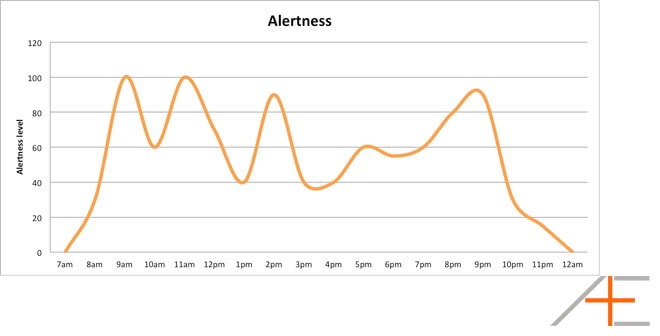
Circadian Rhythm:
As Randall discusses, knowing the circadian rhythm is vital to getting the most out of one's day. Trying to do important work during dips in energy is often very unproductive, as many eastern football players have experienced.
Sunday, January 5, 2014
TOW #14: "Stranger Danger" by Misha Collins (Visual Text)
Misha Collins, an actor and published poet, wrote and directed the video short "Stranger Danger". It is about just that: the danger of strangers. The video features a young girl skipping down a neighborhood street who ultimately enters a suspicious-looking white van. Through this video, Collins conveys the message to his audience – virtually anyone – that one should not judge the safety of others based solely on their appearance. To achieve this, Collins uses irony.
The video begins by following a young girl as she walks down a neighborhood street, presumably after getting off of the school bus. From the outset, the viewer trusts this girl, who is dressed in pink and seems cheerful and altogether normal. She waves to her neighbors and smells the flowers by the sidewalk. Then, the video cuts to a shot from the inside of a vehicle, in which a man is smoking and looking at the little girl. The man begins to drive slowly behind the girl, and viewers begin to think of him as a predator – they immediately distrust him. The van stops near the little girl, and she looks inside at a Barbie doll. Seemingly trusting the vehicle, she heads towards the side doors. At this point, viewers become very worried for the innocent girl. The man throws the doors open, and, much to the viewers' surprise, the little girl sprouts fangs and leaps at the man, sinking her teeth into him. This alarming twist causes watchers to reconsider how they perceived the people in the video. The man may not have had good intentions, but not once did they consider that the seemingly innocent little girl would have evil intentions as well. Through his use of irony, Collins effectively forces viewers to really think about how they judge people based on their looks, and makes them realize that just because a stranger looks safe doesn't mean that they actually are.
In the video short "Stranger Danger", Misha Collins successfully conveys his message of not judging the safety of others based only upon their appearance. By employing irony through a twist ending, Collins shocks readers into reconsidering their perspective on strangers altogether. He hopes, surely, that if many people view his video, the world may ultimately be a slightly safer place.
The video begins by following a young girl as she walks down a neighborhood street, presumably after getting off of the school bus. From the outset, the viewer trusts this girl, who is dressed in pink and seems cheerful and altogether normal. She waves to her neighbors and smells the flowers by the sidewalk. Then, the video cuts to a shot from the inside of a vehicle, in which a man is smoking and looking at the little girl. The man begins to drive slowly behind the girl, and viewers begin to think of him as a predator – they immediately distrust him. The van stops near the little girl, and she looks inside at a Barbie doll. Seemingly trusting the vehicle, she heads towards the side doors. At this point, viewers become very worried for the innocent girl. The man throws the doors open, and, much to the viewers' surprise, the little girl sprouts fangs and leaps at the man, sinking her teeth into him. This alarming twist causes watchers to reconsider how they perceived the people in the video. The man may not have had good intentions, but not once did they consider that the seemingly innocent little girl would have evil intentions as well. Through his use of irony, Collins effectively forces viewers to really think about how they judge people based on their looks, and makes them realize that just because a stranger looks safe doesn't mean that they actually are.
In the video short "Stranger Danger", Misha Collins successfully conveys his message of not judging the safety of others based only upon their appearance. By employing irony through a twist ending, Collins shocks readers into reconsidering their perspective on strangers altogether. He hopes, surely, that if many people view his video, the world may ultimately be a slightly safer place.
Subscribe to:
Posts (Atom)